Painting and the New Deal Art and Work on the Wpa
 Eagle and palette design regarded as the logo of the Federal Fine art Project | |
| Agency overview | |
|---|---|
| Formed | 29 August 1935 (1935-08-29) |
| Dissolved | 1943 (1943) |
| Jurisdiction | United States |
| Headquarters | Washington, D.C. |
| Bureau executive |
|
| Parent department | Works Progress Administration (WPA) |
The Federal Art Project (1935–1943) was a New Deal program to fund the visual arts in the U.s.a.. Under national director Holger Cahill, it was 1 of v Federal Projection Number One projects sponsored past the Works Progress Administration (WPA), and the largest of the New Bargain art projects. It was created not every bit a cultural activity, but as a relief measure out to use artists and artisans to create murals, easel paintings, sculpture, graphic fine art, posters, photography, theatre scenic design, and arts and crafts. The WPA Federal Art Projection established more than than 100 community art centers throughout the country, researched and documented American blueprint, deputed a pregnant body of public art without restriction to content or subject matter, and sustained some ten,000 artists and craft workers during the Not bad Depression.
Background [edit]
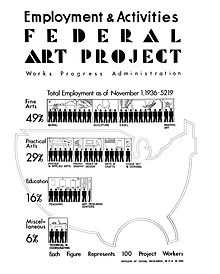
Affiche summarizing Federal Art Project employment and activities (November one, 1936)
The Federal Fine art Project was the visual arts arm of the Great Depression-era WPA, a Federal One program. Funded under the Emergency Relief Appropriation Act of 1935, it operated from August 29, 1935, until June thirty, 1943. It was created as a relief measure to employ artists and artisans to create murals, easel paintings, sculpture, graphic art, posters, photographs, Index of American Design documentation, museum and theatre scenic design, and arts and crafts. The Federal Art Project operated customs art centers throughout the land where craft workers and artists worked, exhibited, and educated others.[2] The project created more than 200,000 separate works, some of them remaining amongst the virtually meaning pieces of public fine art in the country.[3]
The Federal Art Project'southward primary goals were to employ out-of-work artists and to provide fine art for nonfederal municipal buildings and public spaces. Artists were paid $23.60 a week; tax-supported institutions such as schools, hospitals, and public buildings paid only for materials.[four] The piece of work was divided into art production, art instruction, and art research. The chief output of the art-enquiry grouping was the Index of American Design, a mammoth and comprehensive written report of American material culture.
Every bit many as ten,000 artists were commissioned to produce work for the WPA Federal Art Project,[5] the largest of the New Bargain art projects. Three comparable but distinctly divide New Bargain art projects were administered by the United States Department of the Treasury: the Public Works of Art Projection (1933–1934), the Section of Painting and Sculpture (1934–1943), and the Treasury Relief Art Project (1935–1938).[half-dozen]
The WPA program made no distinction between representational and nonrepresentational art. Brainchild had not yet gained favor in the 1930s and 1940s, so was virtually unsalable. As a result, the Federal Fine art Project supported such iconic artists equally Jackson Pollock before their work could earn them income.[7]
One detail success was the Milwaukee Handicraft Projection, which started in 1935 as an experiment that employed 900 people who were classified as unemployable due to their age or disability.[ane] : 164 The project came to employ about 5,000 unskilled workers, many of them women and the long-term unemployed. Historian John Gurda observed that the urban center's unemployment hovered at xl% in 1933. "In that yr," he said, "53 per centum of Milwaukee'south property taxes went unpaid because people just could not beget to brand the taxation payments."[8] Workers were taught bookbinding, block printing, and design, which they used to create handmade art books and children's books. They produced toys, dolls,[9] theatre costumes, quilts,[viii] rugs, draperies, wall hangings, and furniture that were purchased by schools, hospitals,[1] : 164 and municipal organizations[10] for the cost of materials merely.[11] In 2014, when the Museum of Wisconsin Art mounted an exhibition of items created by the Milwaukee Handicraft Project, article of furniture from information technology was all the same existence used at the Milwaukee Public Library.[eight]
Holger Cahill was national manager of the Federal Art Project. Other administrators included Audrey McMahon, director of the New York Region (New York, New Bailiwick of jersey, and Philadelphia); Cloudless B. Haupers, manager for Minnesota;[12] George Godfrey Thorp (Illinois), [thirteen] and Robert Bruce Inverarity, manager for Washington. Regional New York supervisors of the Federal Fine art Project have included sculptor William Ehrich (1897–1960) of the Buffalo Unit (1938–1939), project director of the Buffalo Zoo expansion.[14]
Notable artists [edit]
Some 10,000 artists were deputed to work for the Federal Art Project.[v] Notable artists include the post-obit:
- William Abbenseth[15]
- Berenice Abbott[16]
- Ida York Abelman[1] : 178
- Gertrude Abercrombie[17]
- Benjamin Abramowitz[18]
- Abe Ajay[xix]
- Ivan Albright[1] : 161
- Maxine Albro[twenty]
- Charles Alston[21]
- Harold Ambellan[22]
- Luis Arenal[23]
- Bruce Ariss[24]
- Victor Arnautoff[25]
- Sheva Ausubel[26]
- Jozef Bakos[27]
- Henry Bannarn[28]
- Belle Baranceanu[29]
- Patrociño Barela[thirty]
- Will Barnet[31]
- Richmond Barthé[32]
- Herbert Bayer[1] : 195
- William Baziotes[33]
- Lester Beall[1] : 194
- Harrison Begay[34]
- Daisy Maud Bellis[35] [36]
- Rainey Bennett[37] : 138
- Aaron Berkman[38]
- Leon Bibel[39]
- Robert Blackburn[1] : 170
- Arnold Blanch[37] : 153
- Lucile Blanch[twoscore]
- Lucienne Bloch[4]
- Aaron Bohrod[37] : 144
- Ilya Bolotowsky[41] [42]
- Adele Brandeis[43]
- Louise Brann[44]
- Edgar Britton[37] : 138
- Manuel Bromberg[45]
- James Brooks[46] [47]
- Selma Shush[48]
- Letterio Calapai[49]
- Samuel Cashwan[37] : 156
- Giorgio Cavallon[50]
- Daniel Celentano[51]
- Dane Chanase[52]
- Fay Chong[53]
- Claude Clark[54]
- Max Arthur Cohn[55]
- Eldzier Cortor[56]
- Arthur Covey[57]
- Alfred D. Crimi[58]
- Francis Criss[59]
- Allan Crite[37] : 144
- Robert Cronbach[22]
- John Steuart Curry[57]
- Philip Campbell Curtis[sixty]
- James Daugherty[57]
- Stuart Davis[61]
- Adolf Dehn[62]
- Willem de Kooning[1] : 186
- Burgoyne Diller[63]
- Isami Doi[64]
- Mabel Dwight[one] : 180, 182
- Ruth Egri[65]
- Fritz Eichenberg[66]
- Jacob Elshin[53]
- George Pearse Ennis[67]
- Angna Enters[68]
- Philip Evergood[1] : 161, 174
- Louis Ferstadt[69]
- Alexander Finta[lxx]
- Joseph Fleck[34]
- Seymour Fogel[four] [37] : 138
- Lily Furedi[71]
- Todros Geller[72]
- Aaron Gelman[57]
- Eugenie Gershoy[73]
- Enrico Glicenstein[74]
- Vincent Glinsky[75]
- Bertram Goodman[76]
- Arshile Gorky[1] : 186
- Harry Gottlieb[37] : 154
- Blanche Grambs[37] : 154
- Morris Graves[53]
- Balcomb Greene[42]
- Marion Greenwood[77]
- Waylande Gregory[78]
- Philip Guston[1] : 161
- Irving Guyer[79]
- Abraham Harriton[80]
- Marsden Hartley[1] : 161
- Knute Heldner[81]
- August Henkel[82]
- Ralf Henricksen[83]
- Magnus Colcord Heurlin[57]
- Hilaire Hiler[37] : 145
- Louis Hirshman[84] [85]
- Donal Hord[86]
- Axel Horn[87]
- Milton Horn[88]
- Allan Houser[34]
- Eitaro Ishigaki[89]
- Edwin Boyd Johnson[37] : 140
- Sargent Claude Johnson[90]
- Tom Loftin Johnson[91]
- William H. Johnson[92]
- Leonard D. Jungwirth[56]
- Reuben Kadish[93]
- Sheffield Kagy[94]
- Jacob Kainen[95]
- David Karfunkle[96]
- Leon Kelly[37] : 145
- Paul Kelpe[42]
- Troy Kinney[57]
- Georgina Klitgaard[37] : 145
- Gene Kloss[37] : 154
- Karl Knaths[37] : 141, 146
- Edwin B. Knutesen[97]
- Lee Krasner[98]
- Kalman Kubinyi[99]
- Yasuo Kuniyoshi[37] : 154
- Jacob Lawrence[i] : 161
- Edward Laning[37] : 141
- Michael Lantz[100]
- Blanche Lazzell[37] : 154
- Tom Lea[101]
- Lawrence Lebduska[37] : 146
- Joseph LeBoit[102]
- William Robinson Leigh[34]
- Julian E. Levi[37] : 146
- Jack Levine[37] : 146
- Monty Lewis[103]
- Elba Lightfoot[104]
- Abraham Lishinsky[37] : 141
- Michael Loew[105]
- Thomas Gaetano LoMedico[106]
- Louis Lozowick[1] : 168, 171
- Nan Lurie[37] : 155
- Guy Maccoy[107]
- Stanton Macdonald-Wright[108]
- George McNeil[37] : 144
- Moissaye Marans[109]
- David Margolis[110]
- Kyra Markham[37] : 155
- Jack Markow][111]
- Mercedes Thing[112]
- January Matulka[37] : 144
- Dina Melicov[113]
- Hugh Mesibov[114]
- Katherine Milhous[37] : 163
- Jo Mora[115]
- Helmuth Naumer[34]
- Louise Nevelson[116]
- James Michael Newell[117]
- Spencer Baird Nichols[57]
- Elizabeth Olds[118]
- John Opper[119]
- William C. Palmer[37] : 142 [120]
- Phillip Pavia[57]
- Irene Rice Pereira[121]
- Jackson Pollock[122]
- George Post[37] : 150
- Gregorio Prestopino[37] : 147
- Mac Raboy[123]
- Anton Refregier[37] : 155
- Ad Reinhardt[124]
- Misha Reznikoff[37] : 147
- Mischa Richter[57]
- Diego Rivera[125]
- José de Rivera[126]
- Emanuel Glicen Romano[127]
- Mark Rothko[ane] : 161
- Alexander Rummler[57]
- Augusta Fell[128] [129]
- Concetta Scaravaglione[37] : 157
- Louis Schanker[130]
- Edwin Scheier[131]
- Mary Scheier[131]
- Carl Schmitt[57]
- William Southward. Schwartz[37] : 147
- Georgette Seabrooke[132]
- Ben Shahn[133] [134]
- William Howard Shuster[135]
- Mitchell Siporin[136]
- John French Sloan[5]
- Joseph Solman[137]
- William Sommer[37] : 151
- Isaac Soyer[138]
- Moses Soyer[1] : 161
- Raphael Soyer[1] : 32
- Ralph Stackpole[139]
- Cesare Stea[140]
- Walter Steinhart[57]
- Joseph Stella[one] : 175
- Harry Sternberg[ane] : 167
- Sakari Suzuki[141]
- Albert Swinden[42] [142]
- Rufino Tamayo[37] : 151
- Elizabeth Terrell[37] : 147
- Lenore Thomas[ane] : 323
- Dox Thrash[3] : 373
- Mark Tobey[1] : 161 [53]
- Harry Everett Townsend[57]
- Edward Buk Ulreich[47]
- Charles Umlauf[143]
- Jacques Van Aalten[144]
- Stuyvesant Van Veen[145]
- Herman Volz[146]
- Mark Voris[147]
- John Augustus Walker[148]
- Andrew Winter[v]
- Jean Xceron[149]
- Edgar Yaeger[150]
- Bernard Zakheim[151] [152]
- Karl Zerbe[37] : 148
[edit]

Jacksonville Negro Art Eye, Jacksonville, Florida


Affiche for the opening of the Mason City Fine art Center, Mason Urban center, Iowa (1941)


Grade at the Harlem Community Fine art Center (January 1, 1938)

Poster for the open up house of the Greensboro Art Heart, Greensboro, North Carolina (1937)


Curry County Art Center, Gold Beach, Oregon
The first federally sponsored community art center opened in December 1936 in Raleigh, Northward Carolina.[153]
| State | Metropolis | Proper name | Notes |
|---|---|---|---|
| Alabama | Birmingham | Extension fine art gallery[3] : 441 | |
| Alabama | Birmingham | Healey School Fine art Gallery | [iii] : 441 |
| Alabama | Mobile | Mobile Fine art Heart, Public Library Edifice | [3] : 441 |
| Arizona | Phoenix | Phoenix Art Eye | [3] : 441 |
| District of Columbia | Washington, D.C. | Children'south Fine art Gallery | [3] : 441 |
| Florida | Bradenton | Bradenton Fine art Middle | [3] : 441 |
| Florida | Coral Gables | Coral Gables Art Gallery | Extension art gallery[3] : 441 |
| Florida | Daytona Beach | Daytona Beach Art Center | [iii] : 441 |
| Florida | Jacksonville | Jacksonville Art Center | [3] : 441 |
| Florida | Jacksonville | Jacksonville Beach Art Gallery | Extension fine art gallery[3] : 441 |
| Florida | Jacksonville | Jacksonville Negro Fine art Center | Extension art gallery[iii] : 441 [154] |
| Florida | Key West | Cardinal West Community Art Eye | [3] : 441 |
| Florida | Miami | Miami Art Heart | [iii] : 441 |
| Florida | Milton | Milton Art Gallery | Extension art gallery[3] : 441 |
| Florida | New Smyrna Beach | New Smyrna Beach Art Centre | [three] : 441 |
| Florida | Ocala | Ocala Art Center | [3] : 441 |
| Florida | Pensacola | Pensacola Art Center | [3] : 441 |
| Florida | Leningrad | Jordan Park Negro Exhibition Center | [3] : 441 |
| Florida | Saint petersburg | Saint petersburg Art Middle | [3] : 442 |
| Florida | St. Petersburg | St. Petersburg Civic Exhibition Middle | [3] : 442 |
| Florida | Tampa | Tampa Fine art Center | [3] : 442 |
| Florida | Tampa | Due west Tampa Negro Art Gallery | [3] : 442 |
| Illinois | Chicago | Hyde Park Art Heart | [3] : 442 |
| Illinois | Chicago | South Side Customs Art Center | [3] : 442 |
| Iowa | Bricklayer City | Mason City Fine art Heart | [3] : 442 |
| Iowa | Ottumwa | Ottumwa Fine art Middle | [three] : 442 |
| Iowa | Sioux Metropolis | Sioux Urban center Art Center | [iii] : 442 |
| Kansas | Topeka | Topeka Art Center | [iii] : 442 |
| Minnesota | Minneapolis | Walker Art Center | [3] : 442 [155] |
| Mississippi | Greenville | Delta Art Center | [3] : 442 |
| Mississippi | Oxford | Oxford Art Center | [3] : 442 [156] |
| Mississippi | Sunflower | Sunflower Canton Art Middle | [three] : 442 |
| Missouri | St. Louis | The People'south Art Center | [3] : 442 |
| Montana | Butte | Butte Art Center | [3] : 442 |
| Montana | Great Falls | Great Falls Art Heart | [3] : 442 |
| New Mexico | Gallup | Gallup Art Center | [3] : 443 [34] |
| New United mexican states | Melrose | Melrose Art Center | [iii] : 443 |
| New United mexican states | Roswell | Roswell Museum and Art Center | [3] : 443 |
| New York City | Brooklyn | Brooklyn Community Art Middle | [3] : 443 |
| New York City | Manhattan | Contemporary Fine art Centre | [3] : 443 [157] |
| New York City | Harlem | Harlem Community Fine art Eye | [3] : 443 |
| New York City | Flushing, Queens | Queensboro Community Art Center | [3] : 443 |
| Northward Carolina | Cary | Cary Gallery | Extension art gallery[3] : 443 |
| North Carolina | Greensboro | Greensboro Fine art Center | [153] |
| North Carolina | Greenville | Greenville Art Gallery | [3] : 443 |
| North Carolina | Raleigh | Crosby-Garfield School | Extension art gallery[3] : 443 |
| North Carolina | Raleigh | Needham B. Broughton High School | Extension fine art gallery[iii] : 443 |
| North Carolina | Raleigh | Raleigh Art Center | [3] : 444 |
| N Carolina | Wilmington | Wilmington Art Centre | [three] : 443 |
| Oklahoma | Bristow | Bristow Art Gallery | Extension art gallery[3] : 443 |
| Oklahoma | Claremore | Claremore Art Gallery | Extension art gallery[3] : 443 |
| Oklahoma | Claremore | Will Rogers Public Library | Extension art gallery[3] : 443 |
| Oklahoma | Clinton | Clinton Art Gallery | Extension fine art gallery[3] : 443 |
| Oklahoma | Cushing | Cushing Fine art Gallery | Extension fine art gallery[3] : 443 |
| Oklahoma | Edmond | Edmond Art Gallery | Extension art gallery[three] : 443 |
| Oklahoma | Marlow | Marlow Art Gallery | Extension art gallery[3] : 443 |
| Oklahoma | Oklahoma City | Oklahoma Fine art Center | [three] : 443 |
| Oklahoma | Okmulgee | Okmulgee Art Center | Extension art gallery[3] : 443 |
| Oklahoma | Sapulpa | Sapulpa Fine art Gallery | Extension art gallery[iii] : 443 |
| Oklahoma | Shawnee | Shawnee Art Gallery | Extension art gallery[3] : 443 |
| Oklahoma | Skiatook | Skiatook Fine art Gallery | Extension art gallery[three] : 443 |
| Oregon | Gold Beach | Curry County Art Center | [3] : 444 |
| Oregon | La Grande | Grande Ronde Valley Art Eye | [3] : 444 |
| Oregon | Salem | Salem Fine art Middle | [3] : 444 |
| Pennsylvania | Somerset | Somerset Fine art Center | [three] : 444 |
| Tennessee | Chattanooga | Hamilton County Fine art Middle | [3] : 444 |
| Tennessee | Memphis | LeMoyne Art Eye | [3] : 444 |
| Tennessee | Nashville | Peabody Fine art Center | [3] : 444 |
| Tennessee | Norris | Anderson County Fine art Center | [three] : 444 |
| Utah | Cedar City | Cedar City Art Exhibition Association | Extension art gallery[3] : 444 |
| Utah | Helper | Helper Community Gallery | Extension art gallery[3] : 444 |
| Utah | Toll | Price Customs Gallery | Extension art gallery[3] : 444 |
| Utah | Provo | Provo Community Gallery | Extension art gallery[iii] : 444 |
| Utah | Salt Lake Urban center | Utah State Art Center | [3] : 444 |
| Virginia | Altavista | Altavista Extension Gallery | Extension art gallery[iii] : 445 |
| Virginia | Big Stone Gap | Big Stone Gap Art Gallery | [3] : 444 |
| Virginia | Lynchburg | Lynchburg Art Gallery | [3] : 444 |
| Virginia | Richmond | Children's Fine art Gallery | [iii] : 444 |
| Virginia | Saluda | Middlesex County Museum | Extension fine art gallery[3] : 444 |
| Washington | Chehalis | Lewis County Exhibition Center | Extension art gallery[3] : 444 |
| Washington | Pullman | Washington State College | Extension art gallery[3] : 444 |
| Washington | Spokane | Spokane Art Center | [3] : 444 [158] |
| West Virginia | Morgantown | Morgantown Art Center | [3] : 445 |
| W Virginia | Parkersburg | Parkersburg Art Eye | [3] : 445 |
| Westward Virginia | Scotts Run | Scotts Run Art Gallery | Extension art gallery[three] : 445 |
| Wyoming | Casper | Casper Fine art Gallery | Extension fine art gallery[3] : 445 |
| Wyoming | Lander | Lander Art Gallery | Extension art gallery[iii] : 445 |
| Wyoming | Laramie | Laramie Art Center | [three] : 445 |
| Wyoming | Newcastle | Lander Art Gallery | Extension art gallery[3] : 445 |
| Wyoming | Rawlins | Rawlins Art Gallery | Extension art gallery[iii] : 445 |
| Wyoming | Riverton | Riverton Art Gallery | Extension art gallery[iii] : 445 |
| Wyoming | Rock Springs | Rock Springs Art Gallery | Extension art gallery[three] : 445 |
| Wyoming | Sheridan | Sheridan Art Gallery | Extension art gallery[3] : 445 |
| Wyoming | Torrington | Torrington Art Gallery | Extension fine art gallery[3] : 445 |
Index of American Pattern [edit]

Federal Fine art Project Illinois poster for an exhibition of the Index of American Design
As we study the drawings of the Alphabetize of American Design nosotros realize that the hands that made the first two hundred years of this country's fabric culture expressed something more untutored artistic instinct and the rude vigor of a frontier civilization. … The Index, in bringing together thousands of particulars from various sections of the state, tells the story of American hand skills and traces intelligible patterns within that story.
—Holger Cahill, national managing director of the Federal Art Project[159] : 15
The Alphabetize of American Blueprint programme of the Federal Fine art Projection produced a pictorial survey of the crafts and decorative arts of the Us from the early colonial period to 1900. Artists working for the Alphabetize produced nearly 18,000 meticulously faithful watercolor drawings,[ane] : 226 documenting material civilization by largely anonymous artisans.[159] : ix Objects range from article of furniture, silver, drinking glass, stoneware and textiles to tavern signs, ships's figureheads, cigar-store figures, carousel horses, toys, tools and weather vanes.[1] : 224 [160] Photography was used only to a limited degree since artists could more accurately and effectively present the form, graphic symbol, color and texture of the objects. The best drawings approach the work of such 19th-century trompe-50'œil painters as William Harnett; bottom works represent the process of artists who were given employment and expert training.[159] : xiv
"It was not a nostalgic or antiquarian enterprise," wrote historian Roger G. Kennedy. "It was initiated by modernists dedicated to abstract design, hoping to influence industrial design — thus in many ways it parallelled the founding philosophy of the Museum of Modern Art in New York."[1] : 224

Like all WPA programs, the Index had the primary purpose of providing employment.[161] Its part was to identify and tape cloth of historical significance that had non been studied and was in danger of being lost. Its aim was to gather together these pictorial records into a torso of material that would class the basis for organic development of American design — a usable American past accessible to artists, designers, manufacturers, museums, libraries and schools. The United States had no unmarried comprehensive drove of authenticated historical native design comparable to those available to scholars, artists and industrial designers in Europe.[162]
"In i sense the Index is a kind of archaeology," wrote Holger Cahill. "It helps to correct a bias which has tended to relegate the work of the craftsman and the folk artist to the subconscious of our history where it can be recovered only past digging. In the past we have lost whole sequences out of their story, and accept all just forgotten the unique contribution of hand skills in our culture."[159] : xv
The Index of American Design operated in 34 states and the District of Columbia from 1935 to 1942. It was founded by Romana Javitz, caput of the Picture Collection of the New York Public Library, and textile designer Ruth Reeves.[1] : 224 Reeves was appointed the start national coordinator; she was succeeded by C. Adolph Glassgold (1936) and Benjamin Knotts (1940). Constance Rourke was national editor.[159] : xii The work is in the collection of the National Gallery of Art in Washington, D.C.[163]
The Alphabetize employed an boilerplate of 300 artists during its six years in performance.[159] : fourteen One artist was Magnus S. Fossum, a longtime farmer who was compelled by the Depression to move from the Midwest to Florida. After he lost his left hand in an accident in 1934, he produced watercolor renderings for the Alphabetize, using magnifiers and drafting instruments for accurateness and precision. Fossum eventually received an insurance settlement that fabricated it possible for him to buy another farm and leave the Federal Art Project.[ane] : 228
In her essay,'Picturing a Usable By,' Virginia Tuttle Clayton, curator of the 2002-2003 exhibition, Drawing on America'due south Past: Folk Art, Modernism, and the Index of American Blueprint, held at the National Gallery of Art noted that "the Index of American Blueprint was the result of an ambitious and artistic effort to furnish for the visual arts a usable past."[164]
-

church of sanctuario at chimayo-console from reredos
-
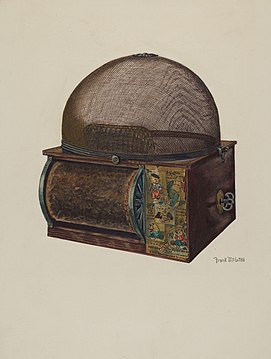
Fly Catcher, 1937.Frank McEntee - National Gallery of Art.
-

Magnus Fossum copying the 1770 Boston Town Coverlet (February 1940)
-

Boston Town Coverlet
Magnus Fossum (1935–1942) -
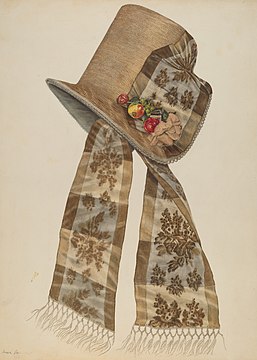
Poke Bonnet,Irene Lawson. Index of American Design.National Gallery of Art
-
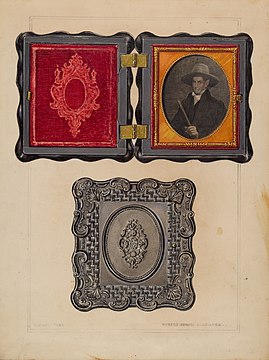
Daguerreotype Case Alphabetize of American Design
-

"Historic period of Knightly" Circus Wagon, c. 1938
-
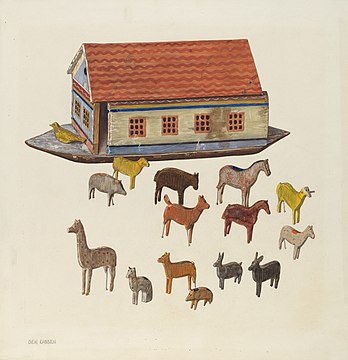
Noah's Ark with animals-Sunday toy
WPA Art Recovery Project [edit]
| External video | |
|---|---|
 | |
 Returning America's Fine art to America, Full general Services Administration[165] Returning America's Fine art to America, Full general Services Administration[165] |
Hundreds of thousands of artworks were commissioned under the Federal Fine art Project.[5] Many of the portable works have been lost, abandoned, or given away as unauthorized gifts. Every bit custodian of the work, which remains federal property, the Full general Services Administration (GSA) maintains an inventory[166] and works with the FBI and fine art community to place and recover WPA art.[167] In 2010, it produced a 22-minute documentary about the WPA Art Recovery Project, "Returning America's Art to America", narrated by Charles Osgood.[168]
In July 2014, the GSA estimated that simply 20,000 of the portable works have been located to date.[166] [169] In 2015, GSA investigators found 122 Federal Art Project paintings in California libraries, where most had been stored and forgotten.[170]
See also [edit]
- Listing of Federal Art Projection artists
- Section of Painting and Sculpture
- Public Works of Art Projection
- Farm Security Administration which employed photographers.
References [edit]
- ^ a b c d east f m h i j k l m due north o p q r s t u 5 w x y z aa ab Kennedy, Roger G.; Larkin, David (2009). When Art Worked: The New Deal, Art, and Democracy. New York: Rizzoli International Publications, Inc. ISBN978-0-8478-3089-3.
- ^ "Employment and Activities affiche for the WPA's Federal Art Project, 1936". Athenaeum of American Fine art. Smithsonian Institution. Retrieved 2015-06-sixteen .
- ^ a b c d e f 1000 h i j k l g due north o p q r s t u 5 w ten y z aa ab ac ad ae af ag ah ai aj ak al am an ao ap aq ar every bit at au av aw ax ay az ba bb bc bd be bf bg bh bi bj bk bl bm bn bo bp bq br bs bt bu bv bw bx by bz ca cb cc cd ce cf cg ch ci cj ck cl cm cn co cp cq Kalfatovic, Martin R. (1994). The New Deal Fine Arts Projects: A Bibliography, 1933–1992. Metuchen, North.J.: Scarecrow Press. ISBN0-8108-2749-2 . Retrieved 2015-06-17 .
- ^ a b c Brenner, Anita (Apr 10, 1938). "America Creates American Murals". The New York Times . Retrieved 2015-06-16 .
- ^ a b c d east Naylor, Brian (April 16, 2014). "New Deal Treasure: Government Searches For Long-Lost Art". All Things Considered. NPR. Retrieved 2015-06-13 .
- ^ "New Deal Artwork: GSA'southward Inventory Project". General Services Administration. Retrieved 2015-06-sixteen .
- ^ Atkins, Robert (1993). ArtSpoke: A Guide to Modern Ideas, Movements, and Buzzwords, 1848-1944. Abbeville Printing. ISBN 978-1-55859-388-6.
- ^ a b c Whaley, K. P. (April 30, 2014). "Depression-Era Milwaukee Handicraft Projection Put Thousands of People to Work". The Kathleen Dunn Show. Wisconsin Public Radio. Retrieved 2015-11-29 .
- ^ "WPA – Milwaukee Handicraft Project". Museum of Wisconsin Art. Retrieved 2015-eleven-29 .
- ^ Roosevelt, Eleanor (November xiii, 1936). "My Twenty-four hour period". Eleanor Roosevelt Papers Project. The George Washington Academy. Retrieved 2015-06-16 .
- ^ "WPA Milwaukee Handicraft Project". School of Continuing Education, Employment and Grooming Establish. University of Wisconsin–Milwaukee. Retrieved 2015-11-29 .
- ^ "WPA Fine art Project". Library. Minnesota Historical Society. Retrieved 2015-11-29 .
- ^ Smithsonian. Archives of American Fine art. George Godfrey Thorp papers, 1941–1970
- ^ Ehrich, Nancy and Roger. "William Ernst Ehrich Biography". Retrieved 17 Baronial 2018.
- ^ "Oral history interview with William Abbenseth". Athenaeum of American Art. Smithsonian Institution. Nov 23, 1964. Retrieved 2015-06-16 .
- ^ "Background". Changing New York. New York Public Library. Retrieved 2015-06-16 .
- ^ "Gertrude Abercrombie papers". Athenaeum of American Art. Smithsonian Institution. Retrieved 2015-06-11 .
- ^ "The Artist and His Life". The Artwork of Benjamin Abramowitz (1917–2011). Southward.A. Rosenbaum & Associates. Archived from the original on 2015-08-12. Retrieved 2015-06-sixteen .
- ^ "Abe Ajay, Industry". The Drove Online. Metropolitan Museum of Art. Retrieved 2015-06-22 .
- ^ "Oral history interview with Maxine Albro and Parker Hall". Archives of American Art. Smithsonian Establishment. July 27, 1964. Retrieved 2015-06-16 .
- ^ "Oral history interview with Charles Henry Alston". Archives of American Art. Smithsonian Establishment. September 28, 1965. Retrieved 2015-06-xvi .
- ^ a b "The Artists of Buffalo's Willert Park Courts Sculptures". Western New York Heritage Printing. Archived from the original on 2010-12-03. Retrieved 2015-06-15 .
- ^ "Luis Arenal". Archives of American Art. Smithsonian Institution. Baronial 7, 1936. Retrieved 2015-06-xiii .
- ^ "Pacific Grove Loftier School Mural – Pacific Grove CA". The Living New Bargain. Department of Geography, University of California, Berkeley. Retrieved 2015-06-fifteen .
- ^ "George Washington High School: Arnautoff Mural – San Francisco CA". The Living New Deal. Section of Geography, University of California, Berkeley. Retrieved 2015-06-xv .
- ^ "Sheva Ausubel". Athenaeum of American Fine art. Smithsonian Institution. March 30, 1937. Retrieved 2015-06-13 .
- ^ "Oral history interview with Jozef and Teresa Bakos, 1965". Archives of American Art. Smithsonian Institution. Retrieved 2016-04-xx .
- ^ "Henry W. Bannarn, ca. 1937". Archives of American Fine art. Smithsonian Institution. Retrieved 2015-06-17 .
- ^ "Belle Baranceanu (1902-1988)". San Diego History Middle. Retrieved 2016-04-20 .
- ^ "Oral history interview with Patrociño Barela". Archives of American Art. Smithsonian Establishment. July two, 1964. Retrieved 2015-06-xv .
- ^ "Volition Barnet, Labor". The Collection Online. Metropolitan Museum of Fine art. Retrieved 2015-06-22 .
- ^ "Richmond Barthe, 1941 April. iv". Archives of American Art. Smithsonian Institution. Retrieved 2015-06-17 .
- ^ "William and Ethel Baziotes papers, 1916–1992". Athenaeum of American Art. Smithsonian Establishment. Retrieved 2015-06-22 .
- ^ a b c d east f "WPA Art Collection – Gallup NM". The Living New Deal. Section of Geography, Academy of California, Berkeley. Retrieved 2015-07-xix .
- ^ Edward Alden Jewell (August 27, 1933). ""Musings Manner Downwards east," New York Times"
- ^ "Bellis, Daisy Maud". Connecticut State Library. 27 Baronial 1933. Retrieved 2 July 2016.
- ^ a b c d east f m h i j 1000 l m due north o p q r s t u v w x y z aa ab ac ad ae af ag ah ai aj ak al Cahill, Holger (1936). Barr, Alfred H. Jr. (ed.). New Horizons in American Art. New York: Museum of Modern Art. OCLC 501632161.
- ^ Abbott, Leala (December 2004). "Arts and Civilization, Art Center records 1930–2004, Finding Aid". Milstein/Rosenthal Middle for Media & Engineering science. 92nd Street Y. Archived from the original on 2015-06-21. Retrieved 2015-06-22 .
- ^ "Leon Bibel: Art, Activism, and the WPA". Lora Robins Gallery of Design from Nature. University of Richmond. Archived from the original on 2015-06-23. Retrieved 2015-06-22 .
- ^ "Lucile Flinch, 1940 Oct. 31". Athenaeum of American Fine art. Smithsonian Establishment. Retrieved 2015-06-17 .
- ^ "1939 World's Fair Mural Written report – Chicago IL". The Living New Deal. Section of Geography, University of California, Berkeley. Retrieved 2015-06-10 .
- ^ a b c d "Williamsburg Housing Evolution Murals – Brooklyn NY". The Living New Deal. Department of Geography, University of California, Berkeley. Retrieved 2015-06-10 .
- ^ "Oral history interview with Adele Brandeis". Archives of American Art. Smithsonian Institution. June 1, 1965. Retrieved 2015-06-eighteen .
- ^ "Louise Brann, ca. 1935". Archives of American Art. Smithsonian Institution. Retrieved 2015-06-17 .
- ^ "Manuel Bromberg, 1939 Jan. 23". Archives of American Art. Smithsonian Institution. Retrieved 2015-06-17 .
- ^ "Oral history interview with James Brooks". Archives of American Fine art. Smithsonian Establishment. June 10–12, 1965. Retrieved 2015-06-17 .
- ^ a b "Bailey, Main Librarian, Praises WPA Art Project". Long Isle Sunday Press. Long Isle, New York. April five, 1936.
- ^ "Selma Shush". Archives of American Fine art. Smithsonian Establishment. Retrieved 2015-06-sixteen .
- ^ "Letterio Calapai, ca. 1937". Archives of American Art. Smithsonian Institution. Retrieved 2015-06-17 .
- ^ "Oral history interview with Giorgio Cavallon, 1974". Archives of American Art. Smithsonian Establishment. Retrieved 2016-04-20 .
- ^ "P.S. 150 Mural – Queens NY". The Living New Deal. Section of Geography, Academy of California, Berkeley. Retrieved 2016-05-eleven .
- ^ "Dane Chanase, 1942 Jan. 26". Archives of American Fine art. Smithsonian Institution. Retrieved 2015-06-17 .
- ^ a b c d Mahoney, Eleanor (2012). "The Federal Art Project in Washington State". The Great Low in Washington State. Pacific Northwest Labor and Civil Rights Project, University of Washington. Retrieved 2015-06-23 .
- ^ "Claude Clark Sr., In the Groove". The Collection Online. Metropolitan Museum of Fine art. Retrieved 2016-04-20 .
- ^ "Max Arthur Cohn". Smithsonian American Fine art Museum. Retrieved 2018-01-25 .
- ^ a b "Recovering America'due south Art for America". General Services Assistants. 2010. Archived from the original on 2015-09-24. Retrieved 2015-06-xvi .
- ^ a b c d e f g h i j k fifty grand "Artists". WPA Art Inventory Project. Connecticut State Library. Archived from the original on 2015-07-04. Retrieved 2015-07-03 .
- ^ "Artist: Alfred D. Crimi". The Living New Deal . Retrieved May 3, 2019.
- ^ "Francis Criss, 1940 October. 29". Athenaeum of American Fine art. Smithsonian Institution. Retrieved 2015-06-17 .
- ^ "History and Mission". Most Us. Phoenix Art Museum. Archived from the original on 2015-09-05. Retrieved 2015-06-22 .
- ^ Conn, Charis (February fifteen, 2013). "Art in Public: Stuart Davis on Abstract Art and the WPA, 1939". Annotations: The NEH Preservation Projection. WNYC. Retrieved 2015-06-16 .
- ^ "Adolf Dehn, 1940 Oct. 29". Archives of American Art. Smithsonian Institution. Retrieved 2015-06-17 .
- ^ "Oral history interview with Burgoyne Diller". Archives of American Art. Smithsonian Institution. October ii, 1964. Retrieved 2015-06-xvi .
- ^ "Isami Doi, Most Coney Isle". The Drove Online. Metropolitan Museum of Art. Retrieved 2015-06-nineteen .
- ^ "Ruth Egri, 1937 Apr. 12". Archives of American Art. Smithsonian Establishment. Retrieved 2015-06-17 .
- ^ "Fritz Eichenberg, April". The Collection Online. Metropolitan Museum of Art. Retrieved 2015-06-22 .
- ^ "George Pearse Ennis, ca. 1936". Archives of American Art. Smithsonian Institution. Retrieved 2015-06-17 .
- ^ "Angna Enters, 1940 Nov. eighteen". Archives of American Fine art. Smithsonian Institution. Retrieved 2015-06-17 .
- ^ "Louis Ferstadt, 1939 Jan. 25". Archives of American Art. Smithsonian Establishment. Retrieved 2015-06-19 .
- ^ "Alexander Finta, 1939 June xiv". Athenaeum of American Art. Smithsonian Establishment. Retrieved 2015-06-17 .
- ^ "Federal Art Project, Photographic Division collection, circa 1920–1965, bulk 1935–1942". Archives of American Art. Smithsonian Institution. Retrieved 2015-11-27 .
- ^ "Activist Arts". A New Deal for the Arts. National Archives and Records Administration. Retrieved 2015-06-17 .
- ^ "Eugenie Gershoy, 1938 Mar. 28". Archives of American Fine art. Smithsonian Institution. Retrieved 2015-06-17 .
- ^ "Enrico Glicenstein, 1940 Sept. 29". Archives of American Art. Smithsonian Institution. Retrieved 2015-06-17 .
- ^ "Vincent Glinsky, 1939 Mar. 8". Archives of American Art. Smithsonian Establishment. Retrieved 2015-06-17 .
- ^ "Bertram Goodman, ca. 1939". Athenaeum of American Art. Smithsonian Establishment. Retrieved 2015-06-17 .
- ^ "Marion Greenwood, 1940 June four". Archives of American Fine art. Smithsonian Institution. Retrieved 2015-06-17 .
- ^ "Waylande Gregory". Archives of American Art. Smithsonian Institution. June 2, 1937. Retrieved 2015-06-16 .
- ^ "Irving Guyer, Reading past Lamplight". The Drove Online. Metropolitan Museum of Art. Retrieved 2015-06-22 .
- ^ "Abraham Harriton, 1938 Aug. 16". Archives of American Art. Smithsonian Institution. Retrieved 2015-06-17 .
- ^ Megraw, Richard (January x, 2011). "Federal Art Project". KnowLA Encyclopedia of Louisiana. Louisiana Endowment for the Humanities. Archived from the original on September 15, 2015. Retrieved 2015-10-25 .
- ^ "August Henkel, ca. 1939". Archives of American Fine art. Smithsonian Establishment. Retrieved 2015-06-17 .
- ^ "Ralf C. Henricksen, 1938". Archives of American Fine art. Smithsonian Establishment. Retrieved 2015-06-17 .
- ^ "Service on the dwelling front In that location's a job for every Pennsylvanian in these noncombatant defence efforts". Library of Congress.
- ^ "Terminate and get your free fag pocketbook Careless matches assistance the Axis". Library of Congress.
- ^ "Donal Hord, 1937". Archives of American Art. Smithsonian Institution. Retrieved 2015-06-17 .
- ^ "Axel Horr [sic], 1940 June 28". Archives of American Art. Smithsonian Institution. Retrieved 2015-06-17 .
- ^ "Milton Horn, c. 1937". Athenaeum of American Art. Smithsonian Establishment. Retrieved 2015-06-17 .
- ^ "Eitaro Ishigaki, ca. 1940". Archives of American Art. Smithsonian Institution. Retrieved 2015-06-17 .
- ^ "Sargent Claude Johnson, Dorothy C.". The Collection Online. Metropolitan Museum of Art. Retrieved 2015-06-22 .
- ^ "Tom Loftin Johnson, 1938". Athenaeum of American Art. Smithsonian Institution. Retrieved 2015-06-17 .
- ^ "William H. Johnson: A Guide for Teachers". American Art Museum and the Renwick Gallery. Smithsonian Institution. Archived from the original on 2015-06-thirteen. Retrieved 2015-06-11 .
- ^ "Reuben Kadish, Conversation with a Quarry Master". The Drove Online. Metropolitan Museum of Fine art. Retrieved 2015-06-22 .
- ^ "Sheffield Kagy, Symphony Conductor". The Collection Online. Metropolitan Museum of Fine art. Retrieved 2015-06-22 .
- ^ "Jacob Kainen, Rooming House". The Collection Online. Metropolitan Museum of Art. Retrieved 2015-06-22 .
- ^ "David Karfunkle, ca. 1938". Archives of American Art. Smithsonian Establishment. Retrieved 2015-06-19 .
- ^ "WPA - Works Progress Administration - New Deal Artists | MOWA Online Archive". wisconsinart.org.
- ^ "Oral history interview with Lee Krasner". Archives of American Fine art. Smithsonian Institution. Nov ii, 1964 – April 11, 1968. Retrieved 2015-06-xv .
- ^ "Kalman Kubinyi, Skaters". The Collection Online. Metropolitan Museum of Art. Retrieved 2015-06-22 .
- ^ "Michael Lantz". Smithsonian American Art Museum. Retrieved 2015-06-19 .
- ^ "New United mexican states Country University: Branson Library Art – Las Cruces NM". The Living New Deal. Section of Geography, University of California, Berkeley. Retrieved 2015-06-10 .
- ^ "Joseph LeBoit, Tranquillity". The Collection Online. Metropolitan Museum of Fine art. Retrieved 2015-06-19 .
- ^ "Monty Lewis, 1938 May 26". Archives of American Fine art. Smithsonian Institution. Retrieved 2015-06-17 .
- ^ "Elba Lightfoot, 1938 Jan. 14". Athenaeum of American Art. Smithsonian Institution. Retrieved 2015-06-19 .
- ^ "Murals Approved of five WPA Artists". The New York Times. Oct 28, 1935. Retrieved 2015-06-24 .
- ^ "Thomas Gaetano Lo Medico, 1938 May 12". Archives of American Art. Smithsonian Institution. Retrieved 2015-06-17 .
- ^ "Oral history interview with Guy and Genoi Pettit Maccoy". Archives of American Art. Smithsonian Establishment. July 24, 1965. Retrieved 2015-06-13 .
- ^ "Federal Art Project Artists, 1937". Archives of American Art. Smithsonian Institution. Retrieved 2015-06-17 .
- ^ "Moissaye Marans, ca. 1939". Archives of American Art. Smithsonian Institution. Retrieved 2015-06-17 .
- ^ "David Margolis, 1940 May 29". Archives of American Art. Smithsonian Institution. Retrieved 2015-06-xix .
- ^ "Jack Markow, Street in Manasquan". The Collection Online. Metropolitan Museum of Art. Retrieved 2015-06-22 .
- ^ "Mercedes Matter Interview Excerpts". Hans Hofmann: Creative person/Teacher, Teacher/Artist. PBS. 2003. Retrieved 2015-06-xv .
- ^ "Dina Melicov, 1939 Apr. 26". Athenaeum of American Fine art. Smithsonian Institution. Retrieved 2015-06-17 .
- ^ "Hugh Mesibov". National Gallery of Art. National Gallery of Art. Retrieved 2021-02-16 .
- ^ "Male monarch Metropolis Loftier School Auditorium Bas Reliefs – Rex City CA". The Living New Deal. Department of Geography, Academy of California, Berkeley. Retrieved 2015-06-17 .
- ^ "Louise Nevelson". Guggenheim Drove Online. Solomon R. Guggenheim Foundation. Retrieved 2015-06-15 .
- ^ "James Michael Newell, ca. 1937". Archives of American Fine art. Smithsonian Institution. Retrieved 2015-06-17 .
- ^ "Elizabeth Olds, 1937". Athenaeum of American Art. Smithsonian Establishment. Retrieved 2015-06-18 .
- ^ Mary Ann Marger (1990-05-07). "Thinking in the Abstract Series". Leningrad Times. St. Petersburg, Florida. p. 1D.
- ^ "William C. Palmer, 1936". Archives of American Fine art. Smithsonian Institution. Retrieved 2015-06-17 .
- ^ "Irene Rice Pereira, 1938 Aug. 22". Archives of American Art. Smithsonian Establishment. Retrieved 2015-06-17 .
- ^ "Jackson Pollock". Guggenheim Collection Online. Solomon R. Guggenheim Foundation. Archived from the original on 2015-05-thirty. Retrieved 2015-06-15 .
- ^ "Mac Raboy, Hitchhiker". The Collection Online. Metropolitan Museum of Art. Retrieved 2015-06-22 .
- ^ "Oral history interview with Advertising Reinhardt". Archives of American Art. Smithsonian Institution. 1964. Retrieved 2015-06-16 .
- ^ "City College of San Francisco: Rivera Mural – San Francisco CA". The Living New Bargain. Department of Geography, University of California, Berkeley. Retrieved 2015-06-15 .
- ^ "Oral history interview with José de Rivera". Athenaeum of American Art. Smithsonian Institution. February 24, 1968. Retrieved 2015-06-12 .
- ^ "Emanuel Glicen Romano, 1936 Nov. 23". Archives of American Art. Smithsonian Institution. Retrieved 2015-06-eighteen .
- ^ "Augusta Savage". Smithsonian American Art Museum. Retrieved 2015-06-10 .
- ^ "The Harp past Augusta Savage". 1939 NY World's Off-white. Archived from the original on 2017-03-12. Retrieved 2015-06-10 .
- ^ "Oral history interview with Louis Schanker". Archives of American Art. Smithsonian Institution. 1963. Retrieved 2015-06-eleven .
- ^ a b "Edwin & Mary Scheier". New Hampshire State Quango on the Arts. February 12, 2015. Retrieved 2015-06-22 .
- ^ Pogrebin, Robin (September 16, 2012). "At Harlem Infirmary, Murals Get a New Life". The New York Times . Retrieved 2015-06-22 .
- ^ "Oral history interview with Ben Shahn". Archives of American Art. Smithsonian Institution. October 3, 1965. Retrieved 2015-06-thirteen .
- ^ "Rikers Island WPA Murals – East Elmhurst NY". The Living New Bargain. Department of Geography, University of California, Berkeley. Retrieved 2015-06-10 .
- ^ "Oral history interview with Will Shuster, 1964". Archives of American Art. Smithsonian Institution. Retrieved 2016-04-20 .
- ^ "Lane Tech College Prep High School Auditorium Mural – Chicago IL". The Living New Deal. Department of Geography, University of California, Berkeley. Retrieved 2015-06-15 .
- ^ "Oral history interview with Joseph Solman". Archives of American Art. Smithsonian Institution. Retrieved 2015-06-13 .
- ^ "Isaac Soyer, A Nickel a Shine". The Drove Online. Metropolitan Museum of Art. Retrieved 2015-06-22 .
- ^ "George Washington Loftier Schoolhouse: Stackpole Landscape – San Francisco CA". The Living New Bargain. Section of Geography, University of California, Berkeley. Retrieved 2015-06-22 .
- ^ "Cesare Stea, 1939 Mar. 2". Archives of American Fine art. Smithsonian Establishment. Retrieved 2015-06-17 .
- ^ "Sakari Suzuki, 1936 Dec. ii". Archives of American Art. Smithsonian Institution. Retrieved 2015-06-14 .
- ^ Dunlap, David Westward. (Nov 5, 2014). "At Time to come Cornell Campus, the First Step in Restoring Murals Is Finding Them". The New York Times . Retrieved 2015-06-22 .
- ^ "Timeline under Charles Umlauf bio on the UMLAUF Website".
- ^ "Jacques Van Aalten, 1938 May 26". Archives of American Art. Smithsonian Institution. Retrieved 2015-06-17 .
- ^ "Stuyvesant Van Veen papers, circa 1926-1988". Athenaeum of American Art. Smithsonian Institution. Retrieved 2015-06-17 .
- ^ "Herman Roderick Volz, Lockout". The Drove Online. Metropolitan Museum of Art. Retrieved 2015-06-22 .
- ^ "Oral history interview with Mark Voris, 1965 February 11". www.aaa.si.edu.
- ^ "Murals by John Augustus Walker on permanent brandish in the Museum of Mobile lobby, Mobile, Alabama". Library of Congress. Retrieved 2015-06-17 .
- ^ "Jean Xceron, 1942 Jan. 13". Archives of American Art. Smithsonian Establishment. Retrieved 2015-06-18 .
- ^ "Edgar L. Yaeger papers, 1923-1989". Archives of American Fine art. Smithsonian Institution. Retrieved 2015-06-17 .
- ^ "California Federal Art Projection papers, 1935-1964". Archives of American Art. Smithsonian Institution. Retrieved 2015-06-23 .
- ^ Nolte, Carl (February 27, 2015). "UCSF to allow public see trove of medical history murals". San Francisco Chronicle . Retrieved 2015-06-23 .
- ^ a b Parker, Thomas C. (October xv, 1938). "Federally Sponsored Customs Fine art Centers". Bulletin of the American Library Association. American Library Association. 32 (11): 807. Archived from the original on September xix, 2015. Retrieved 2015-ten-25 .
- ^ "Children drawing at the Jacksonville Negro Art Center of the WPA Federal Fine art Project- Jacksonville, Florida". Florida Retentivity. State Library and Archives of Florida. Retrieved 2015-ten-27 .
- ^ Rash, John (January 30, 2015). "The Walker's WPA roots are still relevant today". Star Tribune. Minneapolis, Minnesota. Retrieved 2015-06-21 .
- ^ Grieve, Victoria (2009). The Federal Art Project and the Creation of Middlebrow Culture. Urbana: University of Illinois Press. p. 145. ISBN9780252034213.
- ^ Abbott, Leala (December 2004). "Arts and Culture, Art Center records 1930–2004, Finding Assist". Milstein/Rosenthal Eye for Media & Technology. 92nd Street Y. Archived from the original on 2015-06-21. Retrieved 2015-06-21 .
In 1935 and 1936, 92Y, in cooperation with the federal Works Progress Administration (Westward.P.A.) and the New York Urban center Lath of Education, began offering free courses … The Contemporary Art Centre, part of the West.P.A.'s Federal Art Project, offered daytime courses for serious art students and was led by Nathaniel Dirk.
- ^ Mahoney, Eleanor (2012). "The Spokane Arts Middle: Bringing Fine art to the People". The Great Low in Washington State. Pacific Northwest Labor and Civil Rights Project, University of Washington. Retrieved 2015-06-23 .
- ^ a b c d eastward f Cahill, Holger (1950). "Introduction". In Christensen, Erwin O. (ed.). The Alphabetize of American Design . New York: The Macmillan Company. pp. ix–xvii. OCLC 217678.
- ^ Herzberg, Max (October 15, 1950). "American Craftsmanship Offers Beauty and Utility". Newark Evening News.
- ^ Jones, Louis C. (Oct 22, 1950). "Only Yesterday It Was Wooden Indians and Whittled Toys". The New York Times . Retrieved 2015-10-29 .
- ^ Jewell, Edward Alden (March 19, 1939). "Saving Our Usable Past". The New York Times . Retrieved 2015-10-29 .
- ^ "History". Index of American Design. National Gallery of Fine art. Archived from the original on 2015-12-23. Retrieved 2015-10-28 .
- ^ Cartoon on America'due south Past: Folk Fine art, Modernism, and the Index of American Blueprint past Virginia Tuttle Clayton, Elizabeth Stillinger, Erika Doss, and Deborah Chotner. Washington, DC: National Gallery of Art, 2002.
- ^ "Works Progress Assistants (WPA) Art Recovery Project". General Services Administration. Archived from the original on September xix, 2015. Retrieved September 10, 2015.
- ^ a b "New Bargain Artwork: GSA'south Inventory Project". Full general Services Assistants. Retrieved 2015-06-13 .
- ^ "New Deal Artwork: Ownership and Responsibleness". Full general Services Administration. Retrieved 2015-06-13 .
- ^ "Works Progress Administration (WPA) Art Recovery Project". Office of the Inspector General, General Services Administration. Archived from the original on 2015-09-xix. Retrieved 2015-06-xiii .
- ^ MacFarlane, Scott (September 17, 2014). "Lost History: Hunting for WPA Paintings". NBC 4. Washington, D.C. Retrieved 2015-06-13 .
- ^ MacFarlane, Scott (April xx, 2015). "Dozens of Pieces of Lost WPA Art Establish in California". NBC 4. Washington, D.C. Retrieved 2015-06-13 .
Further reading [edit]
- DeNoon, Christopher. Posters of the WPA (Los Angeles: Wheatley Press, 1987).
- Grieve, Victoria. The Federal Art Project and the Creation of Middlebrow Culture (2009) excerpt
- Kennedy, Roger G.; David Larkin (2009). When art worked. New York: Rizzoli. ISBN978-0-8478-3089-3.
- Kelly, Andrew, Kentucky by Pattern: American Civilisation, the Decorative Arts and the Federal Art Project's Index of American Design, University Press of Kentucky, 2015, ISBN 978-0-8131-5567-8
- Russo, Jillian. "The Works Progress Administration Federal Art Project Reconsidered." Visual Resource 34.1-ii (2018): thirteen-32.
External links [edit]
- The Living New Deal inquiry project and online public archive at the Academy of California, Berkeley
- Recovering America's Art for America (2010), General Services Assistants short documentary about efforts to recover WPA fine art
- Posters for the People, online archive of WPA posters
- WPA Posters drove at the Library of Congress
- New Deal Art Registry
- wpamurals.com – links to each state, with examples of WPA art in each
- Federal Fine art Projection Photographic Sectionalization collection at the Smithsonian Athenaeum of American Art
- "1934: A New Deal for Artists" Exhibition at the Smithsonian American Art Museum
- "Art Inside Achieve": Federal Art Project Community Art Centers at George Stonemason University
- WPA Murals and American Abstract Artists at American Abstract Artists
- WPA Prints and Murals in New York
- Collection: "Art of the Works Progress Administration WPA" from the University of Michigan Museum of Art
Source: https://en.wikipedia.org/wiki/Federal_Art_Project
0 Response to "Painting and the New Deal Art and Work on the Wpa"
Postar um comentário